Do You Need an AI Agent in Your Business? A Guide for Italian CEOs
Do you want an AI agent in your business? In most family firms, yes, starting with one process where know-how is at risk. For an Italian PMI, especially one that a family has built over two or three generations, the most valuable thing an agent can do is often not “save time” in the abstract. It is to make the company less dependent on what a handful of people carry in their heads, and to take the daily grind of orders, documents and repeat questions off the team that keeps the firm running. Start with one well-chosen process, keep a person approving every decision that matters, and an agent becomes a practical tool rather than a technology bet.
This guide is for owners, CEOs and the next generation preparing to take over. No jargon, no hype, and no promise that software will replace the people who made the company what it is.
The question behind the question: who knows how things work here?
In many Italian companies, the real operating manual is a person. The founder knows which customer in Germany always pays late but never fails to pay. The commercial director knows which agent in the south needs an extra call before the season. The office manager knows how a particular distributor wants its documents.
That model has served Italy’s family firms extraordinarily well. It becomes fragile at two moments. The first is growth: when orders double, the same three people become a bottleneck. The second is the passaggio generazionale, the handover to the next generation or to an external manager, when decades of informal knowledge must suddenly be written down, or risk being lost.
This is where AI agents fit unusually well, because an agent can only work from knowledge that has been made explicit. Building one forces you to capture how the company really operates, and once captured, that knowledge stays with the company.
Where Italian companies stand today
Adoption is rising quickly, from a low base. According to Istat’s 2025 survey on enterprises and ICT, 16.4% of companies with at least ten employees used at least one AI technology in 2025, up from 8.2% a year earlier. The gap by size is wide: 53.1% of large companies versus 15.7% of SMEs. Among firms that considered AI investments and then did not go ahead, a lack of suitable skills was a barrier for almost 60%.
In other words, most Italian PMI are not behind because they lack interest. They lack someone to translate the technology into their own processes. That translation is the job.
A useful way to picture an agent: the trusted impiegato
To picture an AI agent for business, imagine hiring a reliable office employee who never forgets a procedure. On day one you’d show them the order inbox, the price list, the gestionale, and the rules: which discounts the sales team may offer, which customers need payment before shipping, who signs off on exceptions.
An AI agent is configured in very much that spirit. It receives:
- a precise assignment (“check incoming orders from distributors and prepare them in the gestionale”);
- access to the specific inbox, folder or system that assignment requires, and nothing more;
- the company’s written rules and past examples;
- a person who reviews and approves before anything reaches a customer or a supplier.
Unlike a chatbot that only answers questions, an agent takes the next step in a process: it reads, compares, prepares, and hands over for approval. For a fuller primer, see what an AI agent is.
An Italian example: Intesa Sanpaolo’s Ellis
Italy’s largest bank has been running this kind of assistant for years. Ellis, the virtual assistant of Intesa Sanpaolo’s Filiale Digitale, has been live since at least 2023 in the app, on the website and on the toll-free number. According to the bank, Ellis understands more than 1,000 topics and can carry out more than 20 operations, such as card management, payments and finding documents or transactions, answering in natural language at any hour. When a request needs expertise, for example securities advice or a suspicious transaction, Ellis connects the customer with a human manager of the Digital Branch and supports that manager during the call.
What is worth noticing as a business owner is the division of labour. The assistant takes the routine; the specialist keeps the relationship and the judgement. A 40-person food exporter can use exactly the same split.
Executive, Operational, Task: three kinds of work, all happening at once
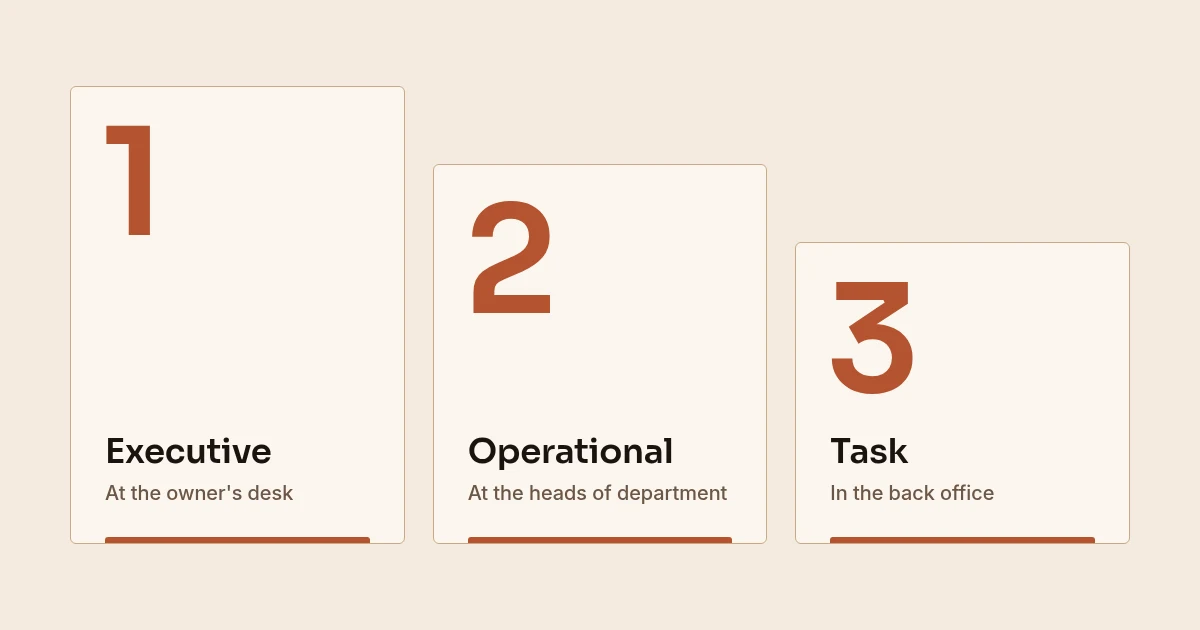
We group agents by three organisational levels. In a family-run Italian company, you might recognise them like this:
- Executive, at the owner’s desk. Few outputs, each one important. Example: every Monday, a two-page note for the owner and the next generation summarising orders by market and by sales agent, unusual payment delays, and the products whose margins slipped last month.
- Operational, at the heads of department. The ongoing flow of sales, after-sales, purchasing and administration, where most of the team’s week goes and where improvement shows up in numbers. Example: managing order confirmations and delivery updates for a network of dealers and agents.
- Task, in the back office. Repetitive work with a clear right answer. Examples: reading data from incoming electronic invoices and transport documents (DDT), matching them to orders, sorting the general inbox, preparing translations of product sheets.
These levels are not a ladder to climb over years. All three exist in your firm right now, side by side, and the decision is simply where to put the first agent. In practice that is usually the Operational or Task level: an Executive agent needs well-organised data underneath it, otherwise there is nothing reliable to summarise. Our post on the 3-tier AI workforce model explains the reasoning.
How we build it: OS47 and one company memory
OS47
theagency47 builds your agents; your team sees and approves their work in OS47, which runs in theagency47's Cloudflare account or your own.
For an owner, the important points are about control:
- Your choice of account. Everything runs in theagency47’s Cloudflare account or your own. If you change suppliers, the code and the data remain yours. More on the OS47 page.
- Each agent sees only its own corner. Access is granted system by system, limited to the task.
- Nothing important happens without a person. Sending to a customer, modifying a record or authorising a payment waits for human approval.
- You can always check what happened. Every action is logged.
- Costs are transparent. Spending is visible, with limits per person or team that you decide.
The Second Brain, or how know-how stops walking out of the door
The second piece is the company’s shared memory. A Second Brain, as we use the term, is a well-organised set of plain text files containing your procedures, price rules, customer conditions and past decisions, used and updated by both your staff and your agents. The idea originated as a personal note-taking method; ours is a company-wide archive owned by the business.
For a firm approaching a generational handover, this is often the most valuable deliverable on its own. The knowledge that used to live in the founder’s memory and in a few long email threads becomes a resource the whole company can consult. Agents grow it over time by writing back resolved cases and decisions, and when an answer is missing they flag the gap rather than inventing something. Our research on the company second brain looks at where this approach works and where it doesn’t.
What it could look like in fashion, food and manufacturing
The following are illustrative scenarios, not client stories.
A fashion brand selling wholesale. After each showroom season, buyers from a dozen countries send orders, changes and sample requests in different languages and formats. A Task agent extracts and normalises them; an Operational agent prepares confirmations and flags conflicts with production capacity for the commercial team to approve.
A food producer that exports. Distributors keep asking the same things: allergen information, shelf life, certificates, pallet configurations. An agent answers from the Second Brain with the correct, approved documents, and routes anything unusual, such as a new market’s labelling rules, to quality or export staff. See our notes on food and beverage exporters.
A precision-engineering subcontractor. Customers send technical drawings and requests for quotation. An agent reads the request, retrieves similar past jobs and their costing, and drafts a quote for the technical office to review. After-sales questions about spare parts get the same treatment. More on industrial components.
Curious how an agent actually behaves in conversation? The voice agent on the theagency47 homepage answers questions about what we do; a short chat with it says more than a long explanation.
Rules and the AI Act, in brief
EU AI Act. The European regulation on AI has been in force since August 2024 and applies gradually. Typical back-office agents (orders, documents, customer service) are generally not classed as high-risk, while some uses, such as screening job candidates, can be. People should be made aware when they are dealing with an AI system.
Your people. Tell your staff early what an agent will do and what it records, and involve your labour consultant from the start.
Where to begin
A sensible first step for a PMI looks like this:
- Choose the process that frustrates people most, not the one that sounds most innovative. Order entry and repeat customer questions are common candidates.
- Write down how it works today, including the unwritten rules. This alone often reveals quick wins.
- Run one agent for a few months with narrow access and human approval, measure the hours and errors, and decide together whether to extend it.
For costs, see our pricing. If you want a quick self-assessment first, the free AI Readiness Scorecard takes a few minutes, and the ROI calculator helps estimate payback.
FAQ
Is this only for large companies?
No. The Istat figures show smaller firms are behind mainly because of missing skills, not because the technology doesn't fit them. A single, well-scoped agent is a realistic project for a company of 20 or 50 people.
How do we involve the next generation and long-serving staff?
Make them co-authors. Long-serving employees know the unwritten rules the Second Brain needs; the next generation often drives the rollout. People approve the agent's work, so they stay in control.
Does it work in Italian?
Yes. The agents work in any language the chosen model supports, including Italian, and we test each agent in your working languages before handover.
Can it work with our gestionale and electronic invoices?
In most cases, yes, through a connector to your management software or to the files you already receive. Which connections you need is checked in discovery and quoted separately.
Do we need to tell our staff?
Yes, and early. Explain what each agent does and what it records; your labour consultant can confirm the formal steps, and we provide the documentation of every agent.
What is OS47?
OS47 is theagency47's client workspace for AI agents: a private web app where your team sees what your agents know and do, approves every reply and knowledge change before it is sent, checks each agent against test questions with known answers, and can stop every agent at once.
Guides by country: Greece · Germany · Italy · France
Written by Christos Papadimitriou, founder of theagency47.