Do You Need an AI Agent in Your Business? A Guide for French CEOs
Do you want an AI agent in your business? If you run a PME or an ETI in France, here is a short answer: probably yes, but only where the work is frequent, rule-based enough to describe, and painful enough that your team would happily hand it over. Customer requests in retail, quotes and scheduling in service companies, supplier paperwork in every sector: these are the places where a supervised agent tends to pay its way. The condition is doing it in a way your DPO, your CSE and the CNIL’s guidance would recognise as responsible, with clear limits, human approval for decisions, and a record of what the agent did.
This guide is written for the dirigeant, the person who signs, decides and too often ends up answering the emails nobody else could. It skips the jargon and sticks to what changes in your company.
The dirigeant’s real bottleneck
Talk to the head of a 120-person French company and a familiar picture emerges. Growth is possible, but every new customer adds requests that land on the same desks. The sales administration team re-keys orders. The after-sales team answers “where is my order?” for the tenth time today. Store managers send reports in five different formats. And when something unusual happens, it escalates to the top, because the person who knows the answer is the founder or one of two long-standing managers.
The technology to absorb part of this load exists, and French companies are starting to use it. Insee reports that 18% of French companies with ten or more employees used at least one AI technology in 2025, three times the 2023 level. Size still makes a big difference: 58% of companies with 250 or more employees, against 15% of those with 10 to 49. For most PME, in other words, the question is still open, and that is an opportunity as much as a risk.
What we mean by “agent”, in one paragraph
An AI agent for business is software given a single, well-defined assignment inside one of your processes, along with the access and the rules needed to carry it out. It reads what comes in (an email, a form, an invoice), works out what should happen next using your procedures, prepares that next step, and passes it to a human for approval when the step matters. It differs from a chatbot because it acts within a workflow instead of just answering, and from a classic automation because it can handle messy, varied inputs. Our explainer on what an AI agent is covers the details.
A French example: Carrefour’s Hopla
French retail has already put this kind of assistant in front of customers. Carrefour launched Hopla on carrefour.fr on 8 June 2023: customers describe a budget, dietary constraints or menu ideas, and the assistant composes baskets, suggests anti-waste recipes and connects to the site’s search so the customer can go straight to purchase.
On 28 September 2026, Carrefour announced a significant upgrade, now also in the Carrefour app. Hopla suggests healthier alternatives after a product search, analyses a finished basket or a photo of a dish to estimate its nutritional balance, and accepts voice commands as well as text.
You don’t need Carrefour’s scale to apply the lesson. Hopla works because it is connected to real data (the product catalogue) and to a real outcome (the basket). A regional retailer or a service company can apply the same logic to its own catalogue, price list or service menu.
Mapping agents to your organisation
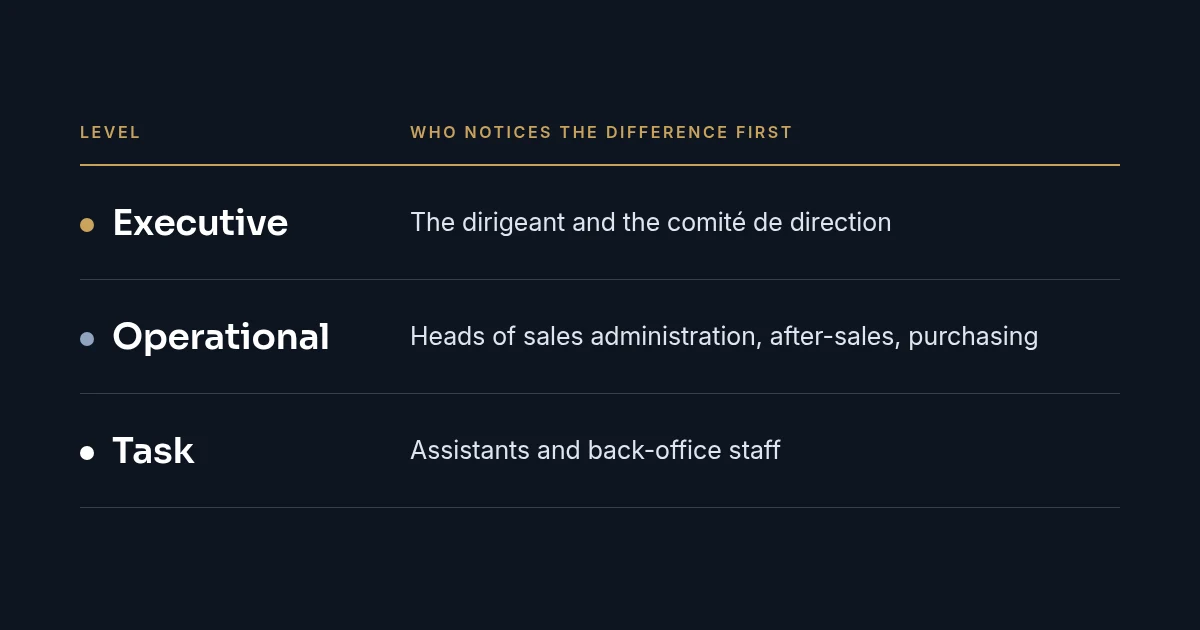
We place agents on three organisational levels. Here is how they tend to show up in a French PME or ETI:
| Level | Who notices the difference first | Shape of the work | Typical first agent |
|---|---|---|---|
| Executive | The dirigeant and the comité de direction | A handful of high-stakes outputs, each needing judgement | A weekly note on cash position, sales by channel and the accounts that need attention |
| Operational | Heads of sales administration, after-sales, purchasing | Continuous departmental flows with measurable service levels | Handling after-sales tickets end to end, preparing B2B quotes for review |
| Task | Assistants and back-office staff | Large volumes of repetitive work that is either right or wrong | Extracting supplier invoice data, consolidating store reports, routing incoming mail |
One frequent misunderstanding: the levels do not describe stages of AI maturity that a company passes through. They are three kinds of work that coexist in your organisation today, and you simply choose where to begin. Our experience is that the first agent usually belongs at the Operational or Task level, because an Executive agent is only as useful as the operational data beneath it. The full argument is in the 3-tier AI workforce model.
GDPR, the CNIL and the AI Act: what a dirigeant should know
French companies tend to ask about compliance first, and rightly so.
GDPR and the CNIL. Agents that process personal data fall under the GDPR like any other system: defined purpose, minimal data, security, information for the people concerned, a processing agreement with suppliers. The CNIL has published a set of practical sheets on AI and the GDPR, and its 2026 work programme announces recommendations on AI used at work and in healthcare. Your DPO should be part of the project from the first meeting.
Employees. When an agent changes how teams work, involve the CSE early and explain what the agent does and what it records. Your employment lawyer can confirm the formal consultation steps for your company.
EU AI Act. The regulation entered into force in August 2024 and applies in stages. Most back-office and customer-service agents are not considered high-risk, though some uses, such as candidate screening, can be. People should be told when they are interacting with an AI system, which is also simply good customer practice.
How theagency47 sets it up
The workspace: OS47
theagency47 builds your agents; your team sees and approves their work in OS47, which runs in theagency47's Cloudflare account or your own.
Concretely, for your company:
- Where it runs. The agents, their settings and their memory sit in theagency47’s Cloudflare account or your company’s own. Details on the OS47 page.
- Minimum access. Each agent is connected only to the systems its assignment requires.
- Human approval where it counts. Anything with consequences (an email to a customer, a change to a record, a payment) waits for a person to validate it.
- Traceability. Every action is logged, which is exactly what your DPO will want to see.
- Budgets under your control. Usage costs are visible, and you set spending limits per person or team.
The memory: a Second Brain
The second piece is shared knowledge. Our Second Brain is a structured base of plain text files (procedures, conditions of sale, product information, answers that worked) which your teams and your agents consult and enrich together. Despite the borrowed name, it is not a personal note-taking system but a company asset you own. If the answer isn’t in it, the agent says so and flags the gap, rather than improvising. We discuss the strengths and limits of this approach in our company second brain research.
Retail and services: three illustrative scenarios
These are examples of typical first projects, not client case studies.
A regional retail chain with 25 stores. Customers write and call about stock, opening hours, returns and orders placed online. An agent answers routine questions from the catalogue and store data, prepares return authorisations for a person to approve, and hands complex complaints to the customer service team with the history attached. See our page on e-commerce.
A facilities-services company (cleaning, maintenance). Requests for quotes arrive from property managers in every format, and technicians send incident reports from the field. A Task agent structures the incoming requests; an Operational agent drafts quotes from your price grid and prepares the next week’s schedule proposal for the planning manager to validate.
A real-estate agency network. Enquiries arrive at all hours from portals, the website and email. An agent qualifies each lead, answers factual questions about listings, proposes viewing slots and passes serious buyers to an adviser. More on real estate.
To see an agent in action before going further, try the voice agent on the theagency47 homepage. It answers questions about our work and gives you a direct feel for the technology.
Getting started without a big programme
- Pick one flow with volume and irritation, such as after-sales emails or supplier invoices.
- Measure today: hours per week, response times, error rates.
- Run a single agent with narrow access and approval on every consequential step, then compare after a few months and decide.
For our own fees, see the pricing page. For a quick self-check, the free AI Readiness Scorecard takes a few minutes.
FAQ
Is an AI agent compatible with the GDPR and CNIL guidance?
It can and should be. We limit each agent to the data its task needs, log every action, keep humans approving decisions, and document the processing so your DPO can assess it against the GDPR and the CNIL's AI guidance.
Do we have to tell customers they are talking to an AI?
Yes, people should know when they are interacting with an AI system. Beyond the legal point, being clear about it tends to build trust rather than reduce it.
Does it work in French?
Yes. The agents work in any language the chosen model supports, including French, and we test each agent in your working languages before handover.
What happens when the agent gets something wrong?
That is why consequential steps need human approval and every action is logged: mistakes are caught before they reach a customer and can be traced afterwards. Each correction also improves the knowledge the agent relies on.
What is OS47?
OS47 is theagency47's client workspace for AI agents: a private web app where your team sees what your agents know and do, approves every reply and knowledge change before it is sent, checks each agent against test questions with known answers, and can stop every agent at once.
Guides by country: Greece · Germany · Italy · France
Written by Christos Papadimitriou, founder of theagency47.