Do You Need an AI Agent in Your Business? A Guide for Greek CEOs
Do you want an AI agent in your business? For most companies in Greece, the honest answer is: yes, for at least one process, but not for everything. An AI agent for business is software that does a defined part of your team’s work, such as answering routine emails, entering orders or preparing a weekly report. It works inside the tools you already use, and it asks a person before anything important happens. What a Greek business gains is time back from repetitive work, faster answers to customers in Greek and English, and company knowledge that stops living only in people’s heads and inboxes.
If you run a company in Greece, you probably know these three problems well:
- Lost time. Your best people spend hours each week on work that never appears on an invoice: copying data, chasing replies, preparing the same report again.
- Repetitive work. The same questions, the same order emails, the same documents to format. Every week.
- Scattered information. The answer exists somewhere: in an email thread, a shared drive, an Excel file or one colleague’s memory. Finding it takes longer than it should.
This guide explains, without technical jargon, what an AI agent is, where it fits in your company, and how we at theagency47 build it.
What an AI agent actually is: a digital colleague
Forget the image of a chat window that answers questions. The easiest way to think about an AI agent is as a digital colleague with a clear job description.
Like a new employee, an AI agent:
- has one role, for example “sort the sales inbox” or “turn supplier invoices into records”;
- gets access only to what it needs: one mailbox, one folder, read-only access to the CRM;
- follows your rules: your prices, your policies, your tone of voice;
- asks before it acts on anything that matters: sending an email to a client, changing a record, paying anything.
The difference from a chatbot is that an agent does not just talk. It reads, decides within limits and carries out the next step. If you want the longer explanation, see our guide on what an AI agent is.
The difference from an employee is that it doesn’t get tired, doesn’t need to be reminded and can work at 3 a.m. when an email arrives. It still needs a manager, though. That is you or one of your people.
Why an AI agent for business belongs inside your processes, not next to them
Many Greek companies have already “tried AI”: someone on the team uses ChatGPT to write an email faster. That helps, but it stays next to the work, not inside it. Someone still copies the result, pastes it into the right system and remembers to follow up.
An AI agent for business is different because it is built into the process itself. The order email arrives, and the agent reads it, checks it against your product list, prepares the order and waits for a person to approve. Nothing gets copied and pasted, and nothing gets forgotten.
This is already happening in Greece at scale. In July 2026 the National Bank of Greece announced that it was the first bank in the country to use AI agents in its phone customer service. Its digital assistant, “Sofia”, understands requests in natural language, answers 24 hours a day and handles tasks such as resetting e-banking passwords or reporting a lost card. When a case needs a person, Sofia transfers the call with the full conversation history, so the customer does not have to repeat anything.
You don’t need to be a bank to use the same idea. The pattern scales down well: the agent handles the routine cases and a person handles the exceptions. In fact, most of the value for smaller companies is in everyday operations rather than technology projects, as we explain in AI agents are coming for operations, not code.
The three organisational levels: where AI fits in your company
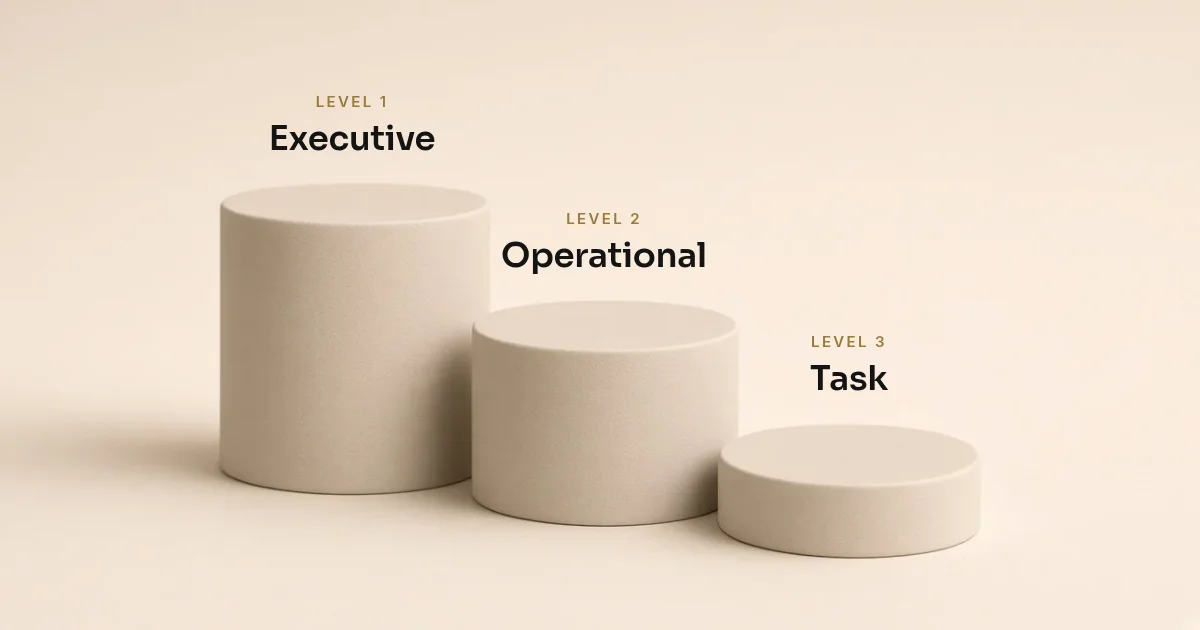
Before you choose an agent, it helps to decide what kind of work it will do. At theagency47 we sort AI agents into three organisational levels that mirror how every business already works:
| Level | What it covers | Examples |
|---|---|---|
| 1. Executive (management) | Decision support and briefings for leadership. Few outputs, a lot of judgment. | A weekly KPI briefing, a market and competitor digest, a board-meeting draft |
| 2. Operational (middle) | The day-to-day flows of a department, such as sales, support and finance. Medium volume, with results you can measure. | Sales follow-ups, first-line customer support, invoice processing |
| 3. Task (execution) | Repetitive, clearly defined work. High volume, and each result is either right or wrong. | Data entry from PDFs and emails, inbox sorting, meeting notes, Greek–English translation |
Three practical points for a CEO:
- Most companies start at Level 2 (Operational). This is where the hours are lost and where results are easiest to measure.
- Level 3 (Task) is the lowest-risk way to test whether AI agents fit your company at all.
- Don’t start at Level 1 (Executive). A briefing agent needs operational data to read. Without it, it has nothing useful to say.
These three levels are not maturity stages. They are layers of work that exist inside every company at the same time, so you do not “climb” from one to the next; you decide which layer to start with. The levels describe the shape of the work, not the name of the department. Marketing, for example, has work at all three levels. If you want the reasoning behind this model, read the 3-tier AI workforce model.
How theagency47 builds it: OS47 + Second Brain
One agent is a good start. Most companies, though, end up with several agents across the three levels, and those agents need a common place to run, a set of rules and access to the same company knowledge. That is what our two building blocks provide.
OS47, in plain words
theagency47 builds your agents; your team sees and approves their work in OS47, which runs in theagency47's Cloudflare account or your own.
What it means for you:
- It runs in theagency47’s Cloudflare account or your own (where OS47 runs). The code and the data remain yours.
- Your existing systems stay where they are. Email, files and CRM are connected with limited, specific access. Nothing has to move.
- Agents start with no access. Each one gets only what its job needs.
- Important actions wait for a human “yes”. Sending an email, changing a record or paying anything is approved by a person first.
- Costs stay visible, with spending limits per person or team that you set.
- It works in Greek. We test every agent in your working languages before handover.
We are an independent agency, not a Cloudflare partner. We build on Cloudflare’s public products.
The Second Brain: your company’s memory
An agent is only as good as what it knows. That is why we build a Second Brain.
In theagency47’s sense, a Second Brain is a company knowledge base of plain text files that your team and your AI agents both read from and write back to. It is not the personal note-taking method of the same name by Tiago Forte, which inspired the idea.
We collect your policies, procedures, price lists, FAQs and past answers, clean them up and organise them so both people and agents can find the right answer. The files belong to you, with no lock-in. When an agent doesn’t find an answer, it doesn’t invent one. It flags the gap so someone can fill it. Each resolved case, decision or meeting summary is written back, so the next task starts with more knowledge than the last. Our research on company second brains covers why this works and where it breaks.
How the two work together across the three levels
Think of it as a building:
- OS47 is the office: the access cards, the rules and the approvals.
- The Second Brain is the company archive and handbook that everyone uses.
- The agents are the colleagues at each level. Task agents handle the inbox and data entry, Operational agents run sales follow-ups or support, and later an Executive agent prepares your Monday briefing from all of it.
Because every agent shares the same knowledge and the same rules, adding the second or third agent is much easier than the first.
What it looks like in a Greek business
A few typical starting points for companies in Greece (illustrations, not case studies):
- A wholesaler or distributor. Orders arrive by email in different formats. A Task agent reads them and prepares the order, and an Operational agent follows up on unpaid invoices. A person approves both.
- A hotel or villa business. Guest questions arrive in five languages at all hours. An agent answers routine questions from the Second Brain and passes special requests to reception with the full context. See AI agents for hotels and villas.
- An accounting office. Clients send invoices and documents in every format. A Task agent extracts the data and an Operational agent tracks deadlines. See AI agents for accounting firms.
See one for yourself. The voice agent on the theagency47 homepage answers questions about what we do. Talk to it for two minutes and you will understand more than any article can explain.
Where to start: three honest steps
- Pick one process that costs you hours every week. Not the most impressive one, the most annoying one.
- Check whether it needs an agent at all. If the steps never change, a simple automation may be enough. An agent makes sense when the work needs judgment, touches several systems and happens often.
- Start small and measure. One agent, a few weeks, a clear before and after. Then expand across the levels.
If you are tempted to build the first agent yourself, compare the real first-year cost first: should you build your own AI agents or pay for OS47?
A simple first 90 days
- Days 1–30: choose and map. Pick the process, write down how it runs today and how you will measure it (hours, errors, response time).
- Days 31–60: build and test. One agent on that process, with limited access and a person approving anything with consequences.
- Days 61–90: measure and decide. Compare before and after. Keep, adjust or stop, and only then choose the next process or level.
Not sure where you stand? Try our free AI Readiness Scorecard or the ROI calculator. You can also learn more about who we are.
FAQ
Do I need technical staff to use an AI agent?
No. We design, build and set up the agents, and we train your team to work with them. Your people approve, correct and give feedback, much as they would with a new colleague.
Will an AI agent replace my employees?
The aim is to take repetitive work off your team, not to remove the people who know your customers. Agents handle routine cases, and your people handle exceptions, relationships and decisions.
Do I have to move my email, files or CRM?
No. Your systems stay where they are. Your agents connect to them with limited, specific access, and your team approves their work in OS47.
Does it work in Greek?
Yes. The agents work in any language the chosen AI model supports, including Greek, and we test each agent in your working languages before handover.
Is it safe to let an agent act on company systems?
Agents start with no access and receive only what their job needs. Anything with consequences, such as sending, changing or paying, waits for a person to approve it, every action is logged, and spending limits are set by you.
What is OS47?
OS47 is theagency47's client workspace for AI agents: a private web app where your team sees what your agents know and do, approves every reply and knowledge change before it is sent, checks each agent against test questions with known answers, and can stop every agent at once.
Written by Christos Papadimitriou, founder of theagency47.