Do You Need an AI Agent in Your Business? A Guide for German CEOs
Do you want an AI agent in your business? Usually yes, for at least one recurring office job. If you lead a Mittelstand company in Germany, the useful version of that question is narrower: which recurring piece of office work could a supervised software agent take over this year, so your scarce specialists can spend their hours on customers, engineering and production instead? For most firms there is at least one such job, usually in order handling, quoting or document control. Introduced properly, with the works council informed early, data protection planned in, and a human signing off on anything that leaves the building, an agent can absorb that work without turning your organisation upside down.
This article is written for managing directors and owners, not IT departments. It covers what an agent is in practice, what a large German bank is already running, how to think about where agents belong, what the Betriebsrat and the GDPR mean for your rollout, and how theagency47 sets it up.
The Mittelstand problem: the work is there, the people aren’t
Ask any Geschäftsführer in Baden-Württemberg, NRW or Saxony what slows growth, and the answer is rarely demand. It is people. Open positions in the back office, in Disposition, in technical sales stay unfilled for months. The colleagues who remain absorb the extra load, and much of it is the least rewarding kind: retyping order confirmations into the ERP, matching delivery notes against invoices, answering the fifth “where is my shipment?” email of the morning.
At the same time, many companies have hesitated. According to Germany’s Federal Statistical Office, 26% of companies with ten or more employees used AI in 2025, with large firms far ahead of small ones. Among companies that had considered AI but not adopted it, the most common reasons were missing know-how (72%), unclear legal consequences (62%) and data protection concerns (60%).
Those three worries are reasonable. They are also solvable, and the rest of this guide addresses each of them.
An AI agent, explained like a new hire in the back office
A good way to understand an AI agent for business is to picture a capable new Sachbearbeiter on their first day. You don’t hand them the keys to everything. You give them a desk, one inbox, read access to the parts of the ERP they need, a binder of procedures and a supervisor who checks their work before anything goes to a customer.
A well-built AI agent is set up the same way:
- One defined job. “Read incoming purchase orders and prepare them for entry” is a job. “Help with sales” is not.
- Narrow permissions. It can see the order mailbox and look up article numbers. It cannot change prices or delete records.
- Your procedures as its rulebook. Delivery terms, discount rules, which customers need a credit check.
- A supervisor’s sign-off. Before a quote goes out or a record is changed, a person approves it.
What makes it different from a chatbot on your website is that it works inside a process: it reads the document, checks it against your data, drafts the next step and hands it to a person for a decision. Our guide on what an AI agent is goes deeper on the technical side, if you want it.
What a large German bank already does: Commerzbank’s Ava
Agents are not a lab experiment in Germany. Since April 2025, Commerzbank customers have been able to use Ava, a virtual assistant inside the banking app. She answers in natural language around the clock, gives customer-specific information, and can carry out tasks within the conversation itself: ordering a new credit card, blocking or unblocking a card, changing limits. When a request gets complicated, the customer is referred to experts in the bank’s customer centre.
How well does that work? In a 2026 interview published by Horváth, Commerzbank COO Christiane Vorspel said Ava handles over 30,000 inquiries per month and resolves more than 70 percent of customer concerns on her own. The pattern matters more than the numbers: routine requests are handled end to end, and anything unusual reaches a person.
A 300-person machine builder is not a bank. The principle transfers, though. Routine, high-volume requests go to the agent. Judgement calls stay with your people.
Three layers of work in a Mittelstand company
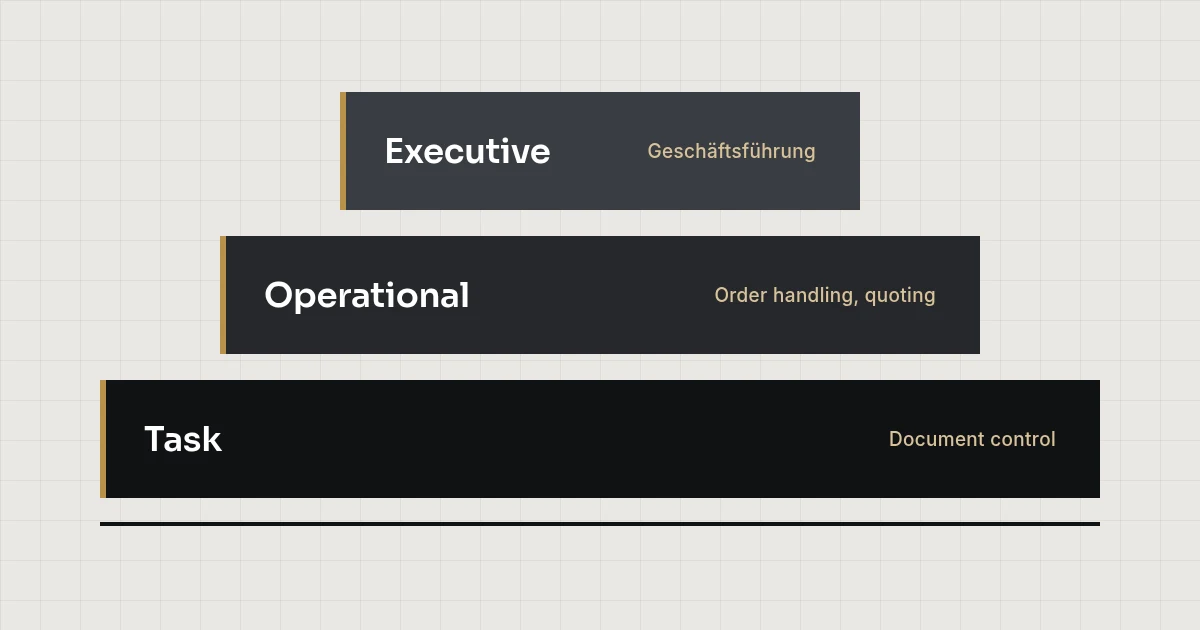
Before choosing a first agent, decide what kind of work it should do. We use a model of three organisational levels, which in a typical German company look roughly like this:
Executive: support for the Geschäftsführung. Low volume, high stakes. Think of a monthly summary for the advisory board that pulls together order intake, margin by product line and the three customers whose payment behaviour changed. The agent drafts; you decide.
Operational: the running of a department. This is where most hours go and where results are easiest to measure. Preparing quotes from incoming RFQs, keeping customers informed about delivery dates, chasing overdue receivables with the right tone for each account.
Task: high-volume, clearly correct-or-incorrect work. Extracting line items from supplier invoices, matching delivery notes to purchase orders, sorting a shared inbox by urgency, filing certificates of conformity against the right batch.
Two remarks. First, these are not maturity stages that you climb one after another. All three layers already exist in your company today, and you choose where to begin. Second, our experience matches the advice on that page: most firms should start with an Operational or Task agent, because an Executive agent needs clean operational data to summarise. The longer argument is in our post on the 3-tier AI workforce model.
Works council and GDPR: plan for them from day one
In many German companies, the fastest way to stall an AI project is to treat the works council as an afterthought. Involve your works council early, before anything is switched on, and let your employment lawyer confirm the formal steps for your company.
Our practical advice: brief the works council before the pilot, not after. Show them which mailbox the agent reads, what it can and cannot do, and what is recorded. In the setup we use, every action an agent takes is logged, which helps with transparency, and it also means you should agree with the works council how those logs may and may not be used. Our guide to AI change management covers how to bring teams and staff representatives along.
On data protection, the GDPR (DSGVO) applies as it would to any system processing personal data: a clear purpose, data minimisation, a data processing agreement and, where needed, a DPIA. We design agents to touch as little personal data as the job requires.
Finally, the EU AI Act. It entered into force in August 2024 and applies in stages. Most back-office agents of the kind described here (sorting email, preparing orders, drafting quotes) are not in the high-risk categories, but uses in areas such as recruitment can be. People should also know when they are interacting with an AI system rather than a person. Check your specific use with counsel; we design for transparency either way.
Where it runs: OS47 and your company memory
Control is a recurring question in German boardrooms, so here is exactly how we set things up.
theagency47 builds your agents; your team sees and approves their work in OS47, which runs in theagency47's Cloudflare account or your own.
In practice that means:
- Your choice of account. Agents, their memory, access rules and budgets live in theagency47’s Cloudflare account or your company’s own. You can read more on the OS47 page.
- Least privilege by default. A new agent can reach nothing until a system is connected for it, scoped to exactly what it needs.
- Consequential actions need approval. Sending, changing or paying waits for a person to say yes.
- A complete audit trail. Every action is logged in your account.
- Visible spending. Model costs are tracked, and you set spending limits per person or team.
- Model choice. Which AI model handles which job is configurable, and we go through those details and the contracts in discovery.
The second building block is the company’s memory. Agents only answer well if they can look things up, so we build a Second Brain: a structured collection of plain text files holding your procedures, product data and past decisions, which employees and agents both read and keep up to date. (The name borrows from a personal productivity method, but this is a shared company knowledge base, not an individual’s notes.) When the agent can’t find an answer there, it says so instead of guessing.
Three scenarios from industry and logistics
These are illustrations of typical first projects, not client case studies.
A special-machinery builder with a spare-parts desk. Requests arrive by email and phone with photos, serial numbers and vague descriptions. A Task agent identifies the machine and the likely part from the serial number and parts lists; an Operational agent prepares the quote with current price and delivery time. The technical salesperson reviews and sends. See our page on industrial components.
A freight forwarder in the Rhine-Ruhr area. Customers want status updates, and documents for each consignment (delivery notes, customs paperwork, proof of delivery) arrive in every format. An agent files each document to the right shipment, flags what is missing before the truck leaves, and drafts status replies for the dispatcher to approve. More on logistics and freight.
A technical wholesaler. Hundreds of purchase orders a week, many as PDF attachments. An agent reads them, checks article numbers and agreed prices, and prepares the order for ERP entry, flagging deviations for a person. Connectors to your existing ERP and accounting tools are scoped and quoted during discovery, not assumed.
If you would like to hear what an agent sounds like before reading more, the voice agent on the theagency47 homepage answers questions about our work. It is a quick, low-effort way to judge the technology yourself.
A pilot your works council can follow
A good first project is small, visible and measurable:
- Weeks 1–3: choose and inform. Pick one process with clear volume, document how it runs today, and brief the works council and your data protection officer.
- Weeks 4–8: build with guardrails. One agent, minimal permissions, human approval on every consequential step, logs reviewed together.
- Weeks 9–12: compare and decide. Hours spent, error rates, response times before and after. Then expand, adjust or stop.
For budget figures, see our pricing page. To get a quick read on where your company stands first, try the free AI Readiness Scorecard.
FAQ
Does our works council have to agree before we start?
Involve your works council early, before the pilot, and agree with them how the agent's logs may be used. Your employment lawyer should confirm the formal steps for your company.
Where is our data, and who controls it?
OS47 runs in theagency47's Cloudflare account or your own, and your existing systems stay where they are. Model providers and contracts are discussed and documented in discovery.
Does it work in German?
Yes. The agents work in any language the chosen model supports, including German, and we test each agent in your working languages before handover.
Can it connect to our existing ERP and accounting tools?
Usually, through a custom connector or interface. We check which systems need connecting during discovery and quote those connectors separately, so nothing is promised that hasn't been checked.
We can't hire enough people. Is this a replacement for staff?
Think of it as relief, not replacement. Agents take over the repetitive part of a role so the people you have can focus on customers and decisions. Approval and responsibility stay with your team.
What is OS47?
OS47 is theagency47's client workspace for AI agents: a private web app where your team sees what your agents know and do, approves every reply and knowledge change before it is sent, checks each agent against test questions with known answers, and can stop every agent at once.
Guides by country: Greece · Germany · Italy · France
Written by Christos Papadimitriou, founder of theagency47.